When you think of classic cookies, Oreo often tops the list. However, if you’re watching your health, it’s important to look beyond taste. Understanding the Oreo nutrition label is essential for anyone tracking calories, ingredients, or dietary preferences. By doing so, you gain insight into what you’re really eating with each bite. Let’s explore the details to make more informed choices.
What is the Oreo Nutrition Label?
Moreover, the Oreo nutrition label provides essential information about calories, fat, carbohydrates, sugars, and other nutrients. Typically, this label breaks down the nutrition for a standard serving size—three cookies (34g). As a result, it helps consumers make better decisions by clearly showing what they’re consuming in each portion.
Oreo Ingredients
Understanding Oreo ingredients is essential if you have dietary restrictions or food preferences. Here’s what’s typically in an original Oreo:
- Sugar
- Unbleached enriched flour (wheat flour, niacin, reduced iron, thiamine mononitrate, riboflavin, folic acid)
- Palm and/or canola oil
- Cocoa (processed with alkali)
- Invert sugar
- Leavening (baking soda and/or calcium phosphate)
- Soy lecithin (emulsifier)
- Salt
- Chocolate
- Artificial flavor
Note: Always check the package as ingredients can vary depending on flavor variations and limited editions.
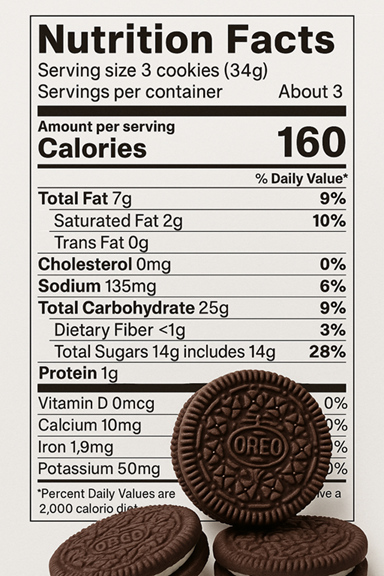
Oreo Nutrition Facts Breakdown
Here’s a detailed breakdown based on one serving (3 cookies — 34g):
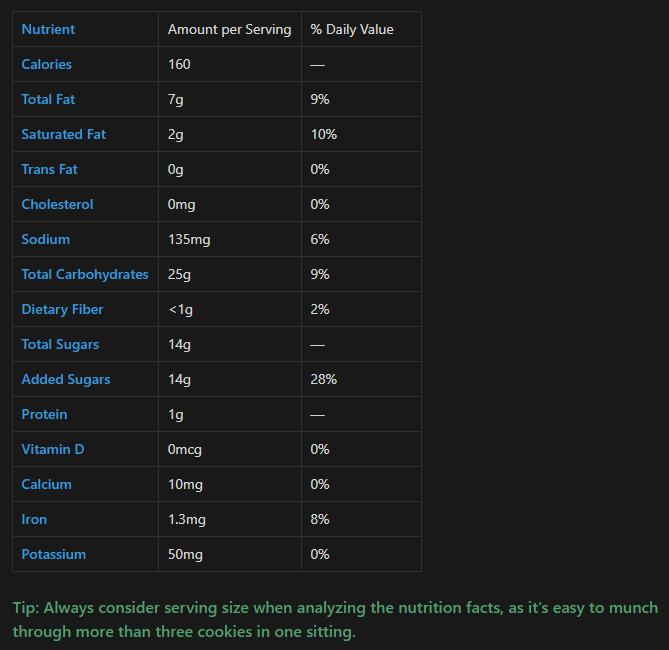
Resource: USDA FOOD DATA CENTRAL: OREO COOKIES
Calories in Oreos
How many calories in an Oreo? On average, one Oreo cookie has about 53 calories. As a result, multiplying this by how many you eat can quickly escalate your calorie intake.
For other versions:
- Oreo Thins (serving of 4 cookies) have about 140 calories.
- Double Stuf Oreos (2 cookies) have about 140 calories.
How Many Oreos Are in a Pack?
If you’re wondering how many Oreos are in a pack, it varies:
- Standard pack: ~36 cookies
- Family pack: ~48 cookies
- Party size: ~90 cookies
Oreo package sizes differ depending on country and edition, so always check before planning your snack portions.
Oreo Thins vs. Original Oreo
Oreo Thins offer a lighter alternative:

While Oreo Thins have fewer calories, they also have less filling and may not satisfy those looking for the classic creamy experience.
Are Oreos Dairy-Free and Halal?
- Do Oreos have dairy? Technically, Oreos are dairy-free. However, cross-contact with milk is possible during production, so they are not guaranteed vegan.
- As for halal status, in most countries, Oreos are considered halal as they do not contain pork or alcohol-derived ingredients. Still, it’s advisable to check certification labels on the Oreo package for confirmation.
Resource: Islamic Food and Nutrition Council: Halal status
Interesting Research Insights
Recent studies and case reports have highlighted some surprising effects:
Oreo Consumption & LDL Cholesterol:
Interestingly, a rare case study found that short-term Oreo consumption—around 12 cookies per day—reduced LDL cholesterol more effectively than high-intensity statin therapy in a keto-adapted individual. This unusual effect, linked to the sudden reintroduction of carbohydrates, is not typical. However, it highlights how refined carbs like Oreos can temporarily influence metabolism in very specific cases (PubMed, 2024).
Overconsumption Risks:
While Oreos are generally safe when eaten in moderation, extreme overconsumption—such as eating very large quantities at once—could potentially disrupt electrolyte balance in rare medical conditions like hypokalemic periodic paralysis (PubMed, 2022). For the vast majority of people, sticking to the recommended serving size of three cookies is a smart and balanced choice.
References:
- Oreo Cookie Treatment Lowers LDL Cholesterol More Than High-Intensity Statin Therapy in a Lean Mass Hyper-Responder on a Ketogenic Diet: A Curious Crossover Experiment. PubMed. Link
- Hypokalemic Periodic Paralysis Exacerbated by Carbohydrate Load: A Case Report. PubMed. Link
For sweet cravings without the processed ingredients, try these [Mediterranean diet-approved desserts] made with nuts and fruit.”